
Post 6

I think the most important issue in how I plan to integrate AI going forward is making sure it does not replace my thinking. Once it starts replacing my role as a thinker, the line between my learning and AI get blurred. If I become completely dependent on artificial intelligence to perform these things as writing, problem solving, or analyzing, I will fail to develop the necessary skills of understanding how to learn and apply knowledge.

I see this clearly in my own academic work. For example, in a statistics assignment, I could use AI to generate a full solution and get the correct answer quickly. Obviously that does not mean I understand the concept or could do it again on my own. When I do the work and solve the problem myself and use AI to check my answer or explain where I went wrong, I am still going through the learning process. The difference is if AI is replacing the work or supporting it.

It matters because AI is going to become part of education and future jobs, so not using it is not a good or smart option. If people rely on it too much, they risk losing core skills and becoming dependent on it. My solution is controlled use, use AI for feedback, clarification, and efficiency, but not as a substitute for learning or decision-making.
Post 5 – Academic AI


I think AI is most helpful right up until it starts doing the thinking for us. When the only real work is Control C and Control V, then it is too much. I think the line is crossed when AI replaces the skills we’re supposed to build. If it writes, summarizes, or analyzes everything for us, then we’re not actually learning those processes. Dinsmore and Fryer (2026) say, “there are no shortcuts” to developing knowledge and expertise. That directly challenges the idea that AI can just “free us” to think at a higher level.

I think the biggest gray area is intent. Using AI to check your understanding or generate ideas can support learning. But using it to produce answers and work can replace learning entirely. The tool isn’t the problem, it is the way it’s used.

I think this will matter even more in future jobs. AI can make work faster, but if people rely on it too much, they risk losing the ability to think independently and know how to execute their job. The goal shouldn’t be to avoid AI, but to use it so that it still makes you think.

Dinsmore, D. L., & Fryer, L. K. (2026). What does current genAI actually mean for student learning? Learning and Individual Differences, 125, 102834. https://doi.org/10.1016/j.lindif.2025.102834

Post 4

At the beginning, my group’s prompt felt simple enough, but I had a feeling the response would miss the point. We typed in “create a poem like it was written by Dr. Seuss” and the response came back technically correct but immediately felt off. It hit the rhyme scheme and kept a steady meter, but it wasn’t the kind of poem that would actually make you feel like you were reading Seuss.

The output that stood out to me was this: “On Maple Street, past the cracked old sign, Lived a kid named Jake in ’09. He rode his bike past Miller’s store, Where the bell still rings on the squeaky door.”

The words rhyme but the reason that I took this part for this answer was not based on its similarities to Seuss but rather its differences. Seuss made up words. He created imaginary creatures with funny-sounding names such as the Lorax and the Sneetches and crafted entire universes from the language itself. This poem sounds like someone who had been told how to describe Dr. Seuss and tried to be him without having any true idea of his style at all.

This connects to something from the Freethink article that stuck with me. The article argues that while AI can find patterns and help explore problems in creative ways, it lacks the human ability to grasp multiple, often competing ideas and shape them into something remarkable (Bhatia, 2025). This is exactly the element missing in the creation made by the LLM. He was blending absurdist humor, social commentary, and invented language all at once.

Growing up, I loved building with Legos freestyle — not from the instructions, but using whatever pieces I had to figure something out on my own. That is still how I understand creativity. Creativity involves not only making something that is novel and unique, but also the intent and thought process that go into creating such a thing. However, I could not say that was reflected at all in this poem. AI might prove to be helpful in terms of coming up with content ideas, but nothing else.

Overall, this experiment confirmed what I already believed, LLMs are impressive at recognizing and reproducing patterns, but creativity is what happens when a person brings something personal and intentional to the work (Bhatia, 2025).

Bhatia, A. (2025). The artifact isn’t the art: Rethinking creativity in the age of AI. Freethink. https://www.freethink.com/opinion/studio-ghibli-chatgpt-creativity

Alec Siegel – Post #3 Prompting LLMs

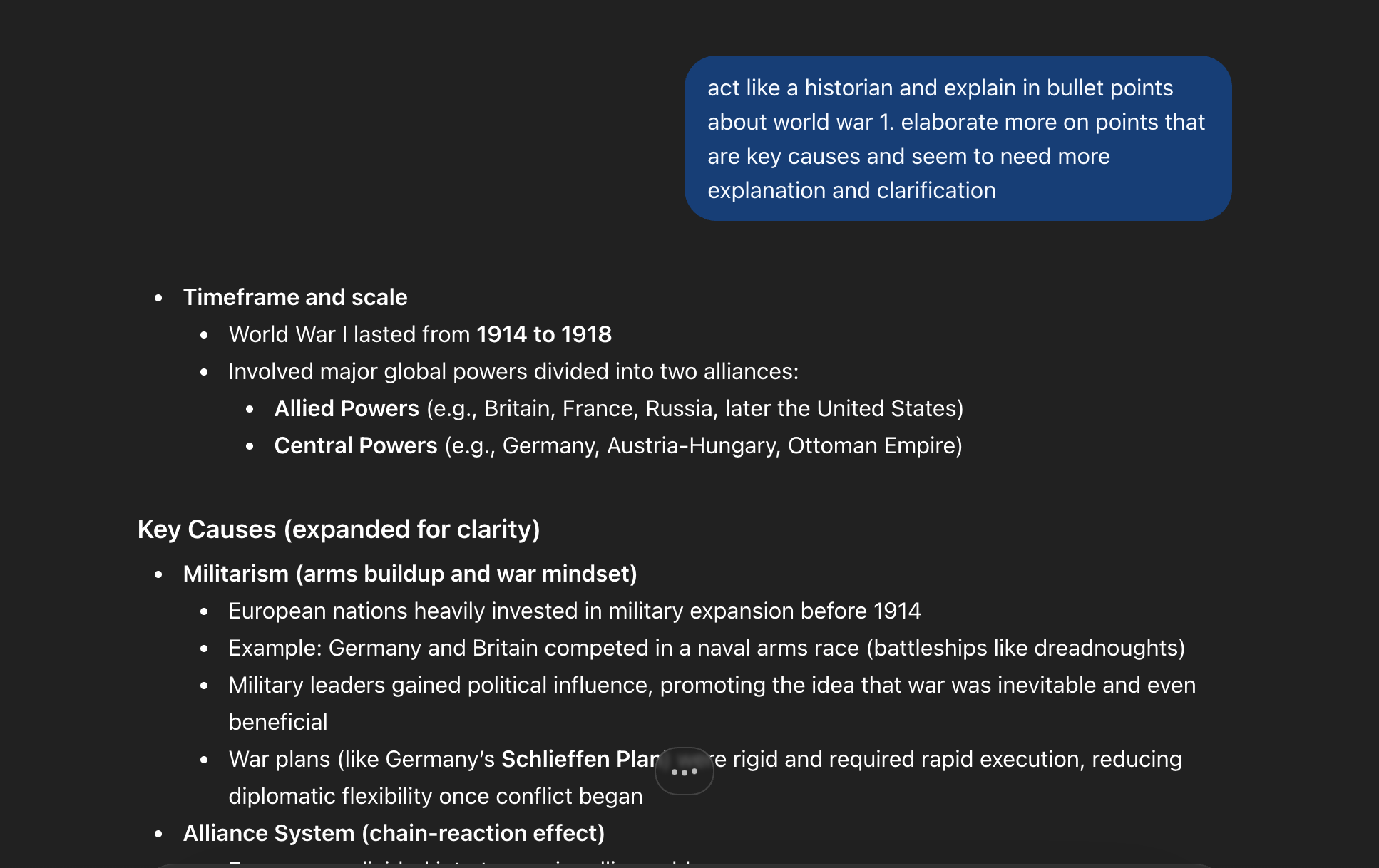
At the beginning, my starter prompt felt like it could work, but I had a feeling the response would be too broad. I typed in “tell me about World War 1” and the response was a general overview that covered everything at a surface level without really getting into any real meaning or depth. It hit the basics like dates and major battles, but it wasn’t the kind of response that would actually help someone understand the war.

The prompt that really helped was the one where I asked it to be a historian and to focus on the key causes and events of the war. This really changed the answer. The answer was more in depth and really went into the causes of the war. The main causes were militarism, alliances, imperialism, and nationalism. The answer really went into the reasons why these were the causes of the war.

Overall, I learned that AI is good at giving detailed, useful information, but only when you tell it exactly what you want. The first prompt gave me something generic because I gave it nothing to work with. Once I added structure and explicit directions, the quality jumped significantly. As the OpenAI Academy reading states, “prompt engineering is the process of designing and refining your input in a way that helps ChatGPT give the best possible answer” (OpenAI Academy, 2025). In order to get good results, the user has to be intentional with how they frame their prompts, and the more specific the instructions, the better and more focused the output will be.

OpenAI Academy. (2025). Prompting. https://academy.openai.com/public/clubs/work-users-ynjqu/resources/prompting

Bias and Misidentification in AI Facial Recognition

In the research lab, my group decided to research the ethical issues related to AI facial recognition technology. In my research, I found that there are two major problems with the use of AI facial recognition technology. The problems are:

First, the facial recognition technology is not equally efficient for all people. Research indicates that the technology is more efficient for white male faces than for women or darker-skinned individuals. The National Institute of Standards and Technology conducted a study that indicated some programs have higher false positive rates for certain racial and ethnic groups. This means the system is more likely to incorrectly identify a person with another person’s face in the database.

Another problem with the use of facial recognition technology is the problem of misidentification, which can lead to the wrong person being arrested. There are already reports of the wrong person being arrested because the facial recognition system incorrectly identified the person. The American Civil Liberties Union (ACLU) reported many cases of the wrong person being arrested because the system incorrectly identified them.

The most surprising thing I learned was how widely this technology is already being used even though researchers have found major accuracy and fairness problems. This made me realize that AI systems like facial recognition can have serious real-world consequences when they are used in law enforcement and security systems.

  1. https://www.nist.gov/programs-projects/face-recognition-vendor-test-frvt (NIST)
  2. https://www.aclu.org/issues/privacy-technology/surveillance-technologies/face-recognition-technology

Introduction

Alec Siegel

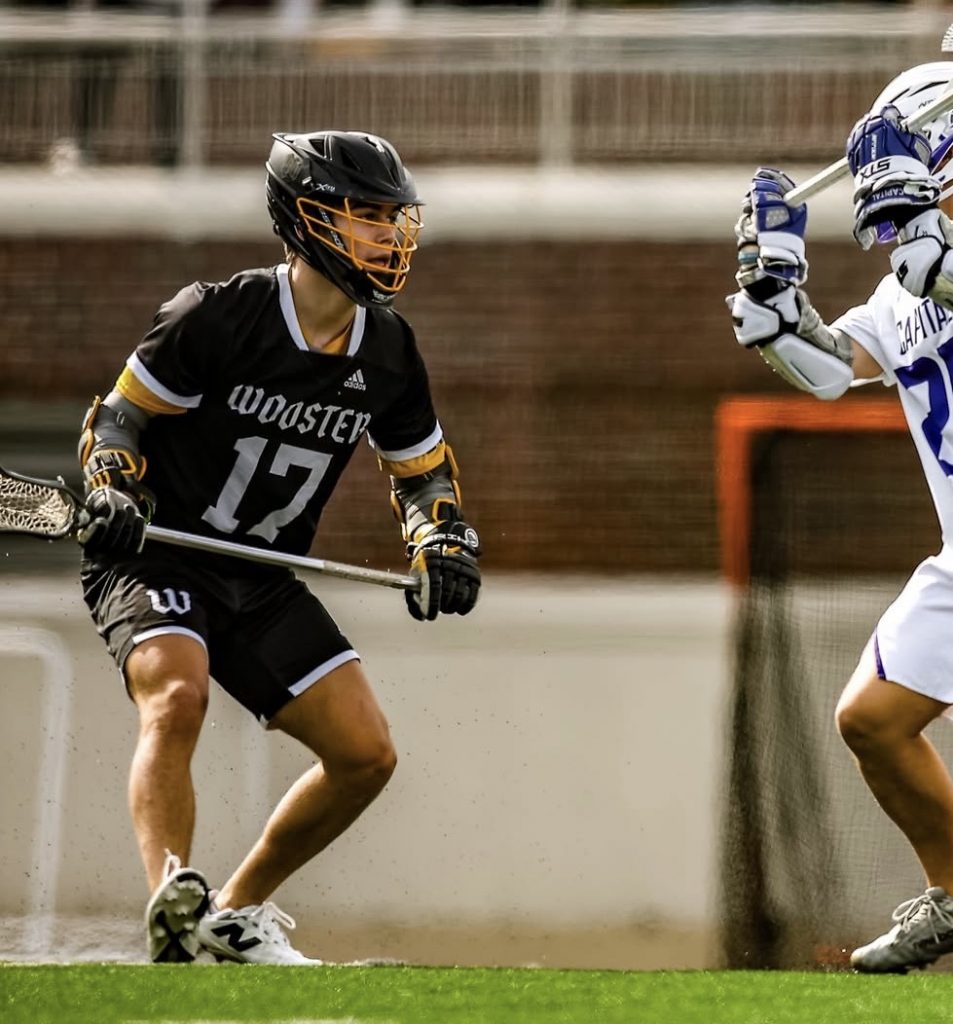
I’m from Princeton, NJ, I play lacrosse here, My pronouns are He/Him, and I like to watch the New York Yankees. My interests in school is economics and business economics. AI plays an important role in our lives today by helping people quickly analyze information and make decisions more efficiently.

Screenshot