Nebiyou
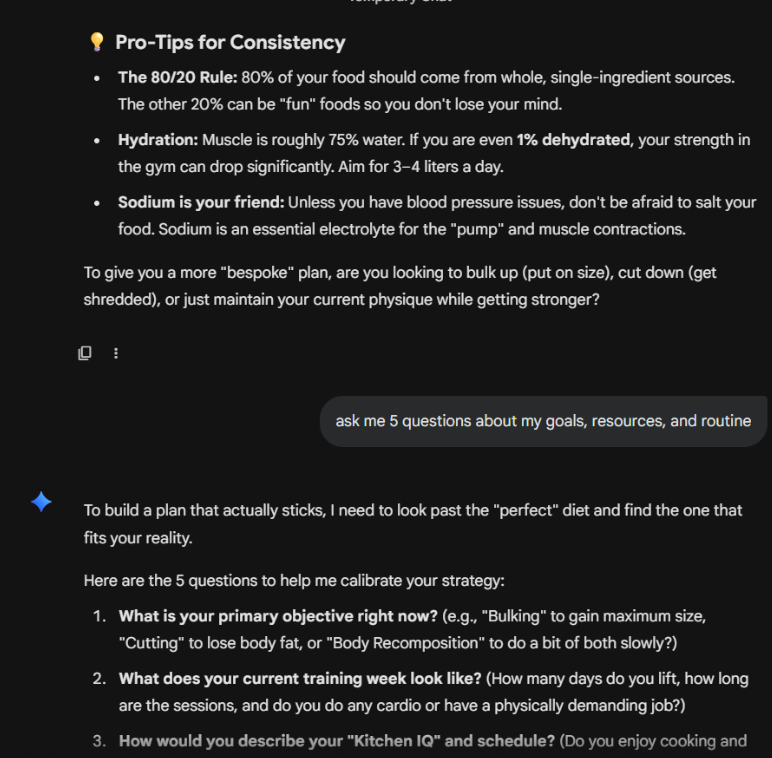
After reading and discussing the prompting guidelines in class Tuesday, my second prompt with Gemini was “Make me a diet for a gymgoer”. I thought this would be fun to try and since I go to the gym as well, I was curious about what recommendation I’d get. The response I got at first was that “we need to move past eating clean and focus on performance fuel”, then it gave me a basic meal plan and nutrition strategy. This was an interesting response, considering I didn’t specify what my training goals were (powerlifting, for athleticism, lifting for mass gain, etc.) Towards the end of the response, it did however ask me if I’m looking to bulk up, cut down, or maintain my physique while getting stronger.
Then I used the Flipping Technique and asked, “Ask me 5 questions about my goals, resources, and routine” and it gave me more focused questions, such as my primary objective, dietary dealbreakers, my current training schedule, and height and weight. I found this to be a lot more helpful and a step in the right direction. This prompt could be very useful for people new to weightlifting or people who have been lifting for a while but may not be seeing the results that they are looking for. I found the flipping technique from Dr. Hayward’s slideshow to be the most useful prompting technique. It’s nice to have the LLM ask questions to kinda home in on what I’m really looking for – since sometimes the prompter themselves might not even be sure what they’re looking for.
For my first prompt I tried, I asked it “Tell me about World War I”, where it gave me an okay overview. My follow up prompt was “You are a history teacher, and i’m a student in your college level class. tell me about the turning points in the world war 1 and the after effects of world war 1 in the western hemisphere”. I used advice from Tips to Get Started and Best Practices from UT’s Prompt Literacy guide, like telling Gemini what role it should take on, the audience, and what the purpose is. “To reduce the likelihood of hallucinations (outputs that sound plausible, but are incorrect or unrelated), tell it that it’s an expert in the topic you’re prompting. For
example, “You are an expert in men’s fashion design.” Other expert role examples
include: Copywriter
o Public Speaker
o Marketing Strategist”
(Under Best Practices)